
Keep interruptive placements like paid social ads at 15 to 30 seconds, organic social posts at 30 to 60 seconds, and landing page or website hero videos at 60 to 90 seconds. When you're not sure which bucket applies, build a 30 second master and cut it down from there. The core rule beats any single magic number: match runtime to placement and viewer intent, then let structure and captions do the rest of the work.
TL;DR:
- Most social and ad placements perform best with videos under 60 seconds, especially 15 to 30 seconds for interruptive channels like paid social ads.
- Landing page and website promos can extend up to 90 seconds, as viewers there expect more proof and are more tolerant of longer content.
- Planning for one main 30 to 60 second master video and trimming cutdowns for different placements saves production time and keeps messaging consistent.
- Script pacing should aim for about 2.2 words per second, with the hook landing within the first 3 to 5 seconds to maximize engagement.
- Production workflows benefit from shooting a comprehensive master first, then creating platform-optimized cutdowns to improve efficiency and coherence.
Table of Contents
- What Is the Ideal Promo Video Length by Platform and Goal?
- How Do You Decide the Right Runtime for a Brief?
- How Fast Should the Script Move?
- What's the Best Workflow for Producing Multiple Video Lengths?
- Why Glenwood Bets on Placement First, Not Runtime First
- Get a Promo Video Built for Every Placement You Need
- Sources
- FAQ
What Is the Ideal Promo Video Length by Platform and Goal?
Runtime isn't a creative decision. It's a placement decision. A viewer scrolling past an ad has already decided to skip you; a visitor who clicked into your landing page has already decided to hear you out. Treat those as two different jobs.
Wistia's analysis of video performance patterns backs this up with a clean framework: videos under one minute work best for awareness and engagement goals, one to five minutes suits education and explainer content, and longer formats belong in retention or training contexts where the viewer already opted in. That single distinction, awareness versus education versus retention, should drive your runtime before you write a single word of script.
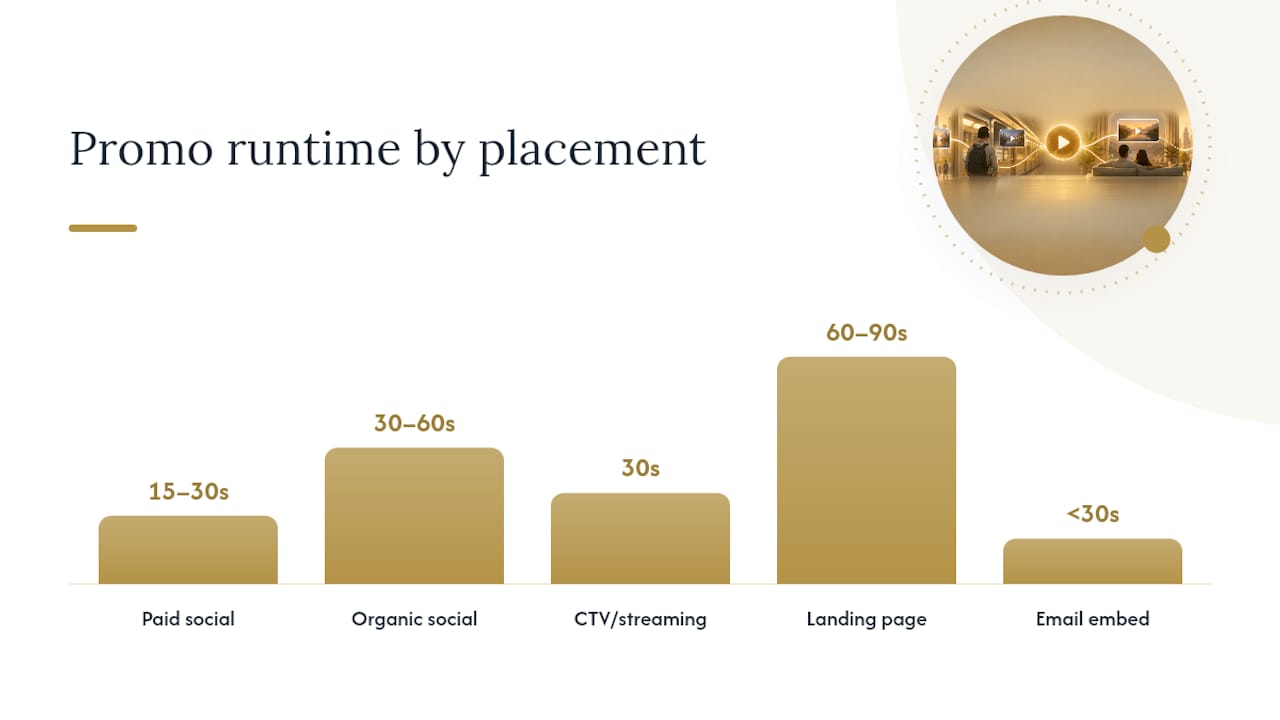
Pictory's guidance narrows this further for promo-specific content: social and ad placements typically perform best between 15 and 60 seconds, while landing page promos can stretch to 60 to 90 seconds because the viewer arrived deliberately and is more tolerant of a longer pitch.
| Placement | Target range | Why |
|---|---|---|
| Paid social ads (Feed/Reels) | 15 to 30 seconds | Interruptive context; viewer hasn't opted in |
| Organic social posts | 30 to 60 seconds | Some intent signal, but still competing with a scroll |
| YouTube pre-roll | 15 to 30 seconds | Needs a strong hook in the first 5 seconds before skip |
| CTV / streaming | 30 seconds | Matches broadcast norms; less skippable, so it can breathe |
| Landing page / website hero | 60 to 90 seconds | Viewer arrived deliberately and expects more proof |
| Email embed | Under 30 seconds | A click already signals interest; don't test their patience twice |
A few platform notes worth flagging directly:
- TikTok and Reels tend to reward 15 to 45 second videos with strong completion rates, especially when the hook lands in the first few seconds.
- HubSpot's channel breakdown notes that autoplay and mute-by-default behavior on Facebook and Instagram push toward shorter, visually driven cuts rather than dialogue-heavy ones.
- CTV inventory behaves more like traditional TV. A 30 second spot is the common denominator advertisers already expect, so straying far from it can feel jarring.
If you remember one number walking away from this table, make it 30. A 30 second cut satisfies most organic social slots outright and serves as the raw material for every shorter cutdown you'll need later. Reserve the 60 to 90 second range for landing pages, where you can actually afford a testimonial or a product demo without losing the viewer.
How Do You Decide the Right Runtime for a Brief?
Before anyone touches a camera, answer five questions. This is a checklist used when scoping a new promo project, and it takes less time to run through than most creative kickoff meetings.
- What's the campaign objective? Awareness, consideration, and conversion each pull runtime in a different direction. Awareness wants brevity; conversion can justify more time if the proof earns it.
- How warm is the audience? Cold audiences on interruptive placements punish anything over 30 seconds. Warm or retargeted audiences, especially on a landing page, will sit through more.
- What proof is mandatory? A testimonial, a live demo, or a before/after comparison eats seconds fast. If the proof is non-negotiable, plan for 60 to 90 seconds and put it on a placement that allows that length.
- What are the placement constraints? A 90 second cut simply won't run as a pre-roll ad. Know your placements before you write the script, not after.
- What KPI are you optimizing? Click-through rate rewards a punchy hook and fast CTA. Completion rate rewards pacing and a tight edit. Lift studies can tolerate a longer, more narrative structure.
The trade-off rule is simple: if you need proof, push the runtime to 60 to 90 seconds and put it somewhere the viewer already chose to be, like a landing page. If you don't need proof, or you're targeting a cold audience on a skippable placement, keep it under 30 seconds no matter how good the footage is.
Pro Tip: Write your brief as four questions before the shoot: what's the one action, what proof is mandatory, what placements will this run on, and which cutdowns are required. Answering these up front saves a full round of reshoots later.
A marketing goals questionnaire can help formalize this process before you brief a production team, especially if multiple stakeholders need to agree on objective and KPI before the camera rolls.
How Fast Should the Script Move?
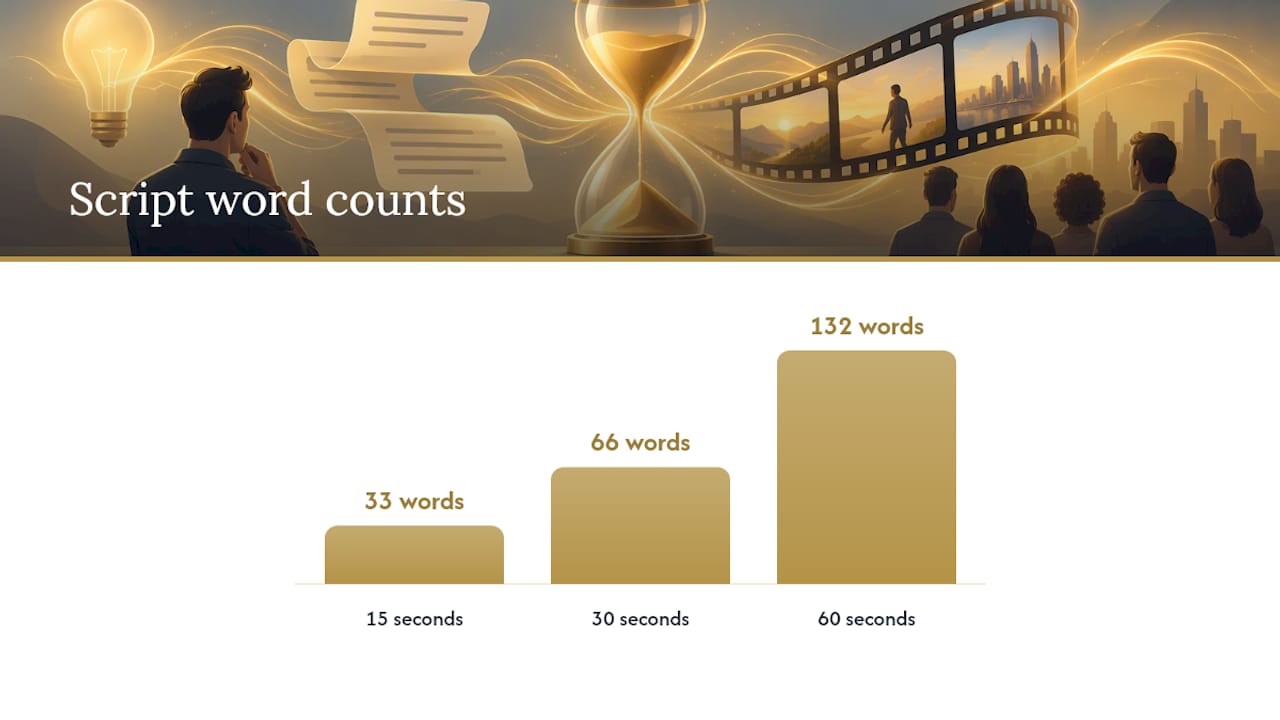
Runtime starts on the page, not in the edit bay. A reliable scripting guideline is about 2.2 words per second of spoken narration. That means a 15-second script runs about 33 words, a 30-second script runs about 66 words, and a 60-second script tops out around 132 words. If your script draft blows past those counts, you already know where the runtime problem started.
The hook has to land in the first 3 to 5 seconds, full stop. On skippable and interruptive placements, that's the only window you get before a thumb moves on, so the primary benefit needs to show up immediately, not after a logo animation or a scene-setting shot.
Captions matter just as much as pacing. Most viewers watch social video on mute, which means your visual proof, on-screen text, and burned-in captions have to carry the message without sound. Assume audio is optional and design for silence first.
What that looks like at each length:
- 15 seconds: Hook, product shot, single CTA. No room for narration beyond a headline.
- 30 seconds: Hook, quick problem statement, fast demo of the payoff, CTA.
- 60 seconds: Hook, problem, demo or testimonial snippet, secondary benefit, CTA.
What's the Best Workflow for Producing Multiple Video Lengths?
Shoot once, cut many times. Producing a 30 to 60 second master and pulling 15 second and 6 second variants from that same footage is far more efficient than scheduling separate shoots for every placement, and it keeps your visual language consistent across channels.
- Shoot the master first. Capture more B-roll and coverage than you think you need. Cutdowns live or die on having extra footage to reframe.
- Edit the master to a tight first cut, then trim 15 to 25% for pacing. First drafts almost always run long. Cutting a quarter of the runtime out is normal, not a failure of the original edit.
- Pull cutdowns from the master's strongest 5 to 10 seconds. The opening hook and the payoff usually survive every shorter version; everything else is negotiable.
- Export for each destination. Deliver 1:1 and 9:16 for social, 16:9 for web and CTV, burned-in captions on every social export, and consistent file naming so nobody uploads the wrong crop.
Pro Tip: Burn critical details like promo codes and dates directly onto the frame. A viewer watching on mute with captions off will still catch a date stamped on screen; they won't catch it in narration they can't hear.
Why Glenwood Bets on Placement First, Not Runtime First
Most creative briefs Glenwood sees start with a length in mind before anyone names the placement, and that's backward. The strongest results come from picking the platform and the viewer's intent first, then letting runtime follow. One nonprofit client needed a fundraising promo that had to work as a 90 second landing page piece and a 15 second social teaser; a single 45 second master, shot with the cutdown in mind, covered both without a second production day. Video Production by Glenwood is built around exactly that master-and-cutdown logic.
— Bo
Get a Promo Video Built for Every Placement You Need
Glenwood Media is the alternative to juggling separate freelancers for every video length your campaign needs. One production day, one master shoot, and you walk away with platform-ready cutdowns instead of a single video stretched to fit places it was never built for.
That means a 15 second ad cut, a 30 to 60 second organic social version, and a longer landing page edit, all captioned and exported in the aspect ratios each platform actually requires: 1:1, 9:16, and 16:9. Glenwood's video production and retainer packages cover this full workflow, from scripting through final export, and current pricing is available directly on the site.
If your next campaign needs a promo video that works across paid social, organic feeds, and your website all at once, start with a project brief. Reach out through Glenwood's contact page to get a production estimate and timeline for your specific placements.
Sources
- Promo Video: How to Make One That Converts — Pictory
- How to Choose the Right Marketing Video Length for Any Goal — Wistia
- How to Make a Promo Video with AI (2026) — Adwave
- Video caption support guidance — DAP (UC Berkeley)
- How long should videos be on Instagram, Twitter, Facebook, YouTube? — HubSpot
FAQ
How Long Is a Typical Promo Video?
Most promo videos run between 15 and 60 seconds for social and ad placements, with 15 to 30 seconds performing best on interruptive channels like paid social ads and pre-roll. Landing page promos can safely run 60 to 90 seconds because the viewer already chose to watch.
How Long Should a Band Promo Video Be?
A band or artist promo aimed at social discovery should stay close to 30 to 45 seconds, matching the same interruptive-placement logic as any other promo ad. If the video lives on a website or EPK page instead, 60 to 90 seconds gives room for a fuller performance clip or story.
Is a 9 Minute Educational Video Too Long?
Not necessarily. Wistia's data places educational and explainer content in the 1 to 5 minute range for most goals, but true tutorial or training content commonly runs longer when the viewer has opted in for depth. A 9 minute runtime only becomes a problem if the content is thin or the pacing drags in the first minute.
Is a 3 Minute Video Too Long for LinkedIn?
It depends on the placement and the audience's intent. A 3 minute video in a LinkedIn feed post is likely too long for cold reach, since feed content behaves like other interruptive social placements and rewards videos under a minute. A 3 minute video linked from a LinkedIn post to a landing page, where the viewer clicks through deliberately, is a different situation entirely and can work well.